Explore how continuous, intermittent and variable pressure profiles differ—and how to interpret the experimental research behind them.
ILLUSTRATED TECHNICAL RESOURCE
01 / THREE PRESSURE PATTERNS
What changes between modes?
01
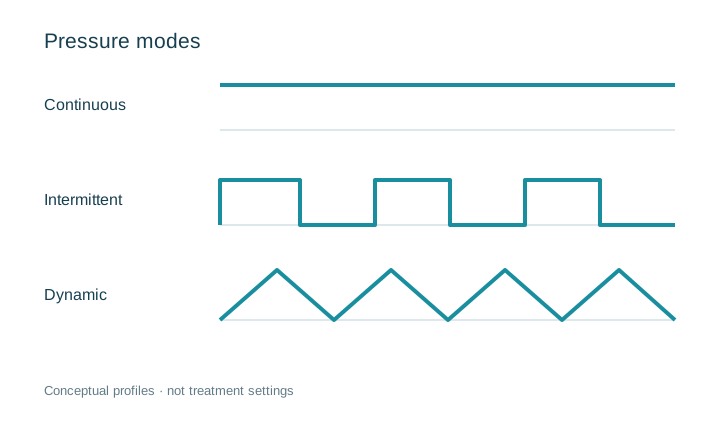
Continuous
A selected negative-pressure level is maintained over time.
A steady target profile.
02
Intermittent
Negative-pressure periods alternate with periods at or near ambient pressure.
An on/off target profile.
03
Dynamic / variable
The target changes between negative-pressure levels while retaining a negative-pressure environment. [3]
A varying target profile.
Illustrations show concepts, not prescribed settings. Ramp shape, timing, pressure limits and mode names depend on the device.
02 / READING THE BIOLOGICAL RESPONSE
Blood flow is not a single number.
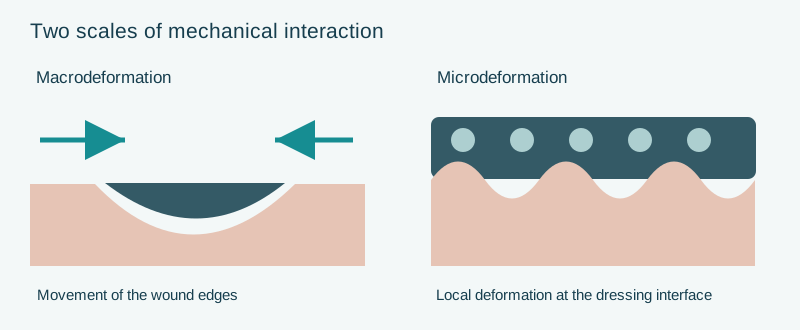
Mechanical interaction is one part of the response. This illustration does not map perfusion values.
The source document traces a shift from early blood-flow observations to studies examining where measurements were taken.
Wackenfors and colleagues studied microvascular flow in a porcine inguinal wound model, considering tissue type and distance from the wound edge. Those variables matter when interpreting a pressure–perfusion graph. [2]
Read the measurement context.
A local observation is not a uniform response across the whole wound. A pressure profile alone cannot establish an individual healing outcome.
03 / THE RESEARCH BEHIND THE IDEA
From early experiments to variable pressure.
1997
Foundational animal studies
Morykwas and colleagues investigated controlled subatmospheric pressure with a foam-and-drape system in animal studies. This is the starting point cited in the supplied reference—not a product-specific human trial. [1]
2004
Location-dependent perfusion
Research examined blood flow by tissue type and distance from the wound edge, adding spatial context to the interpretation of negative pressure. [2]
2012
Comparing pressure profiles and fillers
Malmsjö and colleagues compared continuous, intermittent and variable pressure using foam or gauze in an experimental porcine model. Outcomes included contraction, granulation and tissue ingrowth. This work supports investigation of mode–interface interactions; it does not establish universal superiority or guaranteed pain reduction in patients. [3]
04 / TECHNICAL INTERPRETATION
Separate the profile from the promise.
Question
What to look for
How does pressure change?
Confirm ramp shape, high and low targets, and cycle timing in the model-specific instructions.
What evidence is being cited?
Distinguish animal experiments, bench observations, clinical reports and controlled human trials.
Does the material matter?
Identify the filler used in the study. Findings with one dressing interface do not automatically transfer to another.
What about comfort?
The reference discusses smoother transitions as a design rationale. Patient comfort and clinical suitability require individual assessment.
SOURCE LIBRARY
Read the background reference.
The supplied iNPWT Dynamic Mode document brings together pressure-profile diagrams and research references. The article above distinguishes the experimental evidence from broader clinical claims.
Background reviewed: Dynamic Mode.pdf and dynamic mode.docx supplied for this site. Educational content; settings and mode selection follow the treating clinician and the applicable device instructions.